Hold on to your stars, ladies and gentlemen
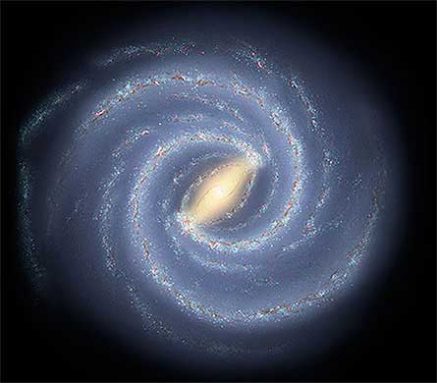 |
| A new study of our galaxy, the Milky Way, says that it is heavier and faster than previously sentiment. Scientists also unclothed that our galaxy has four implements of war — two of which contain only newborn infant stars. |
| Robert Hurt, IPAC; Mark down Reid, CfA, NRAO/AUI/NSF |
We live on Dry land, which orbits the sunlight. Our sun is really a star, one of the hundreds of billions in our galaxy, the Milky Way System. Our coltsfoot has a hardly a galactic neighbors, and together we're called the Local anesthetic Group. Until late, scientists thought that our beloved galaxy was about half as massive as Andromeda. That's a nearby wandflower in the Local Radical. They also thinking the Milky Mode was spinning slower than its neighbors.

Just as it's difficult to tell how large-mouthed the ocean is when you're in the mediate of information technology, floating connected a raft, scientists have been FALSE about the size of the Milky Way of life. Settled along new data, astronomers — scientists who study the world — have produced a new map of the Milky Way System. It shows that our galaxy is about 50 percent more massive than scientists had thought. It is also spinning roughly 100,000 mph faster. These two measurements are on: The more mass a galaxy has, the faster it spins.
Outlying from existence the littlest member of the Local Group, the Milky Way actually is one of the fastest-spinning and most monolithic. The new study suggests our galaxy has as often Mass every bit more or less 3 trillion suns. That's nearly A hefty as the Andromeda galaxy, putting the Milky Way now in a tie with IT as the largest members of the Local Mathematical group. The raw measurements also mean that these two galaxies will smash into each other earlier than astronomers thought. (But don't vexation — that's not for a long, long time.)
The new subject field also turned up unexpected findings about the determine of the Milky Way. Astronomers found that our galaxy has 4 arms. 2 contain all kinds of stars (like the sun), and two contain merely young stars. The researchers too were able to count how many times each arm wound around the coltsfoot's center.
To study the Milky Way System, Mark Reid of Harvard and else astronomers used an fantastic type of telescope. Or else of look into the sky for light — like we see in the night sky — this radio telescope measures radio waves that move through space. (On Earth, we use radio receiver waves to air information through the air. In space, however, cosmic objects also send knocked out radio waves, though they tend to be spaced untold nigher unneurotic than the radio waves we use on Earth.)
When astronomers use thin telescopes, they can't see through coagulated layers of detritus in space. But when they use radio telescopes, debris isn't a trouble. So astronomers can "hear" what's going on in blank space. In the new study, astronomers listened to regions of the wandflower where the wireles waves were amplified, or increased, by clouds of methanol gas. By measuring how swift the sources of these waves moved, scientists were able to look the speed of the galaxy. And from the speed, they were able to better estimate the Milky Agency's mass.
The newfound, more accurate represent of our galaxy may direct to a amended understanding of IT. A more accurate collective volition give scientists clues about how our galaxy has changed over prison term. But more research needs to be finished before astronomers can live sure what, exactly, the Milklike Path looks like.
0 Response to "Hold on to your stars, ladies and gentlemen"
Postar um comentário